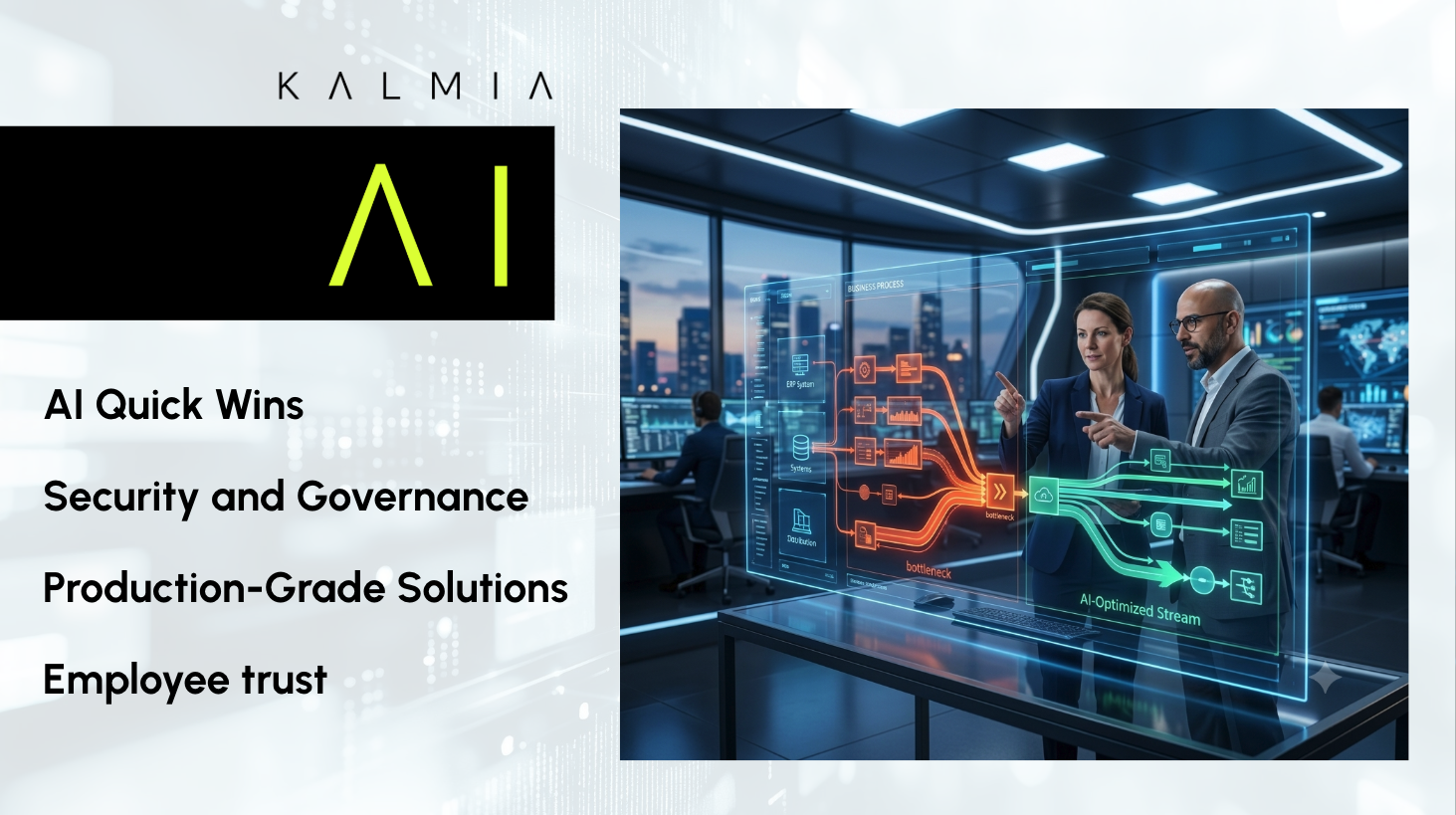
Deploying artificial intelligence solutions in large enterprises has long been more than just a question of technology. Your primary challenge in digital transformation involves governance, data security, and integration with your existing legacy systems. Artificial intelligence is no longer an experiment; it has become an operational necessity for faster, cheaper, and more measurable work, but its successful implementation requires a deliberate approach.
The biggest obstacle to scaling these solutions is not technological; it lies in human trust. Employees and management must recognize the technology as a reliable operational tool. That is why smart companies do not start with large-scale, multi-year projects, but instead focus on optimizing smaller, repetitive processes.
By automating tasks that deliver positive outcomes most quickly and relieve employees of manual work, organizations build trust. When your team sees firsthand how artificial intelligence reduces bottlenecks and eases their daily routine, the path to full automation and production integration becomes significantly faster.
How to build team and management trust through gradual implementation?
When implementing AI solutions, we must not skip steps. Trust is built gradually, from initial problem identification to testing and final rollout.
1. Discovery phase and identification of bottlenecks
-
Problem: Companies often do not know where and how to securely integrate AI solutions into their existing ERP systems without disrupting operations.
-
Solution: A structured "discovery phase," where we review processes with the client and pinpoint the bottlenecks that can be automated most easily.
-
Result: A clear implementation roadmap that minimizes risks and focuses exclusively on processes with the highest ROI.
-
Read more: ERP Bottlenecks and AI Solutions
2. Proof of Concept (PoC) for quick wins
-
Problem: Focusing on a concrete task—e.g., managing administration and travel orders involves a vast amount of repetitive work, driving up costs and lowering employee motivation.
-
Solution: Execution of a limited PoC project, such as introducing an AI agent for processing travel order documents, proving functionality in practice.
-
Result: Proven operational efficiency and gained employee trust before the solution is upgraded with all security measures for production.
-
Read more: AI Agent for Travel Orders
3. Human-in-the-loop and model learning
-
Problem: Full automation in the first step introduces security risks and fear of losing control over processes.
-
Solution: In the initial implementation phase, we introduce a system where AI performs the main work while a human provides final approval, ensuring high-quality feedback for continuous model learning.
-
Result: Reliable and secure integration where the model improves over time until humans only oversee the system through reports.
-
Read more: AI Agent for Checking Shipment Delays
What is the financial impact of strategic technology implementation?
Automating repetitive processes yields a fast return on investment. The timeline of a typical enterprise integration is as follows:
-
Months 1–2: Discovery phase and challenge identification.
-
Months 3–5: Execution and validation of Proof of Concept (PoC) with human verification included.
-
Month 6 onwards: Safe transition to production, scaling, cost reduction, and transition of employees to an exclusively supervisory role.
The table below demonstrates the measurable difference when automating a typical repetitive administrative process:
| Metric | Current State | State with AI Automation |
| Number of monthly requests | 1,000 manually processed | 1,000 autonomously processed |
| Required FTE (Full-Time Equivalent) | 3 employees | 0.5 employees (oversight only) |
| Annual labor cost | €90,000 | €15,000 |
| Technology implementation cost | €0 | €25,000 (one-time + maintenance) |
| Annual savings | €0 | €45,000+ |
Competitive advantage lies in the speed of adaptation
Companies that understand AI is primarily an operational tool for solving concrete challenges are already creating a significant competitive advantage today. Early adoption and gradual, secure implementation—taking into account legacy systems and data governance—allow teams to focus on strategic tasks while AI takes over routine work.