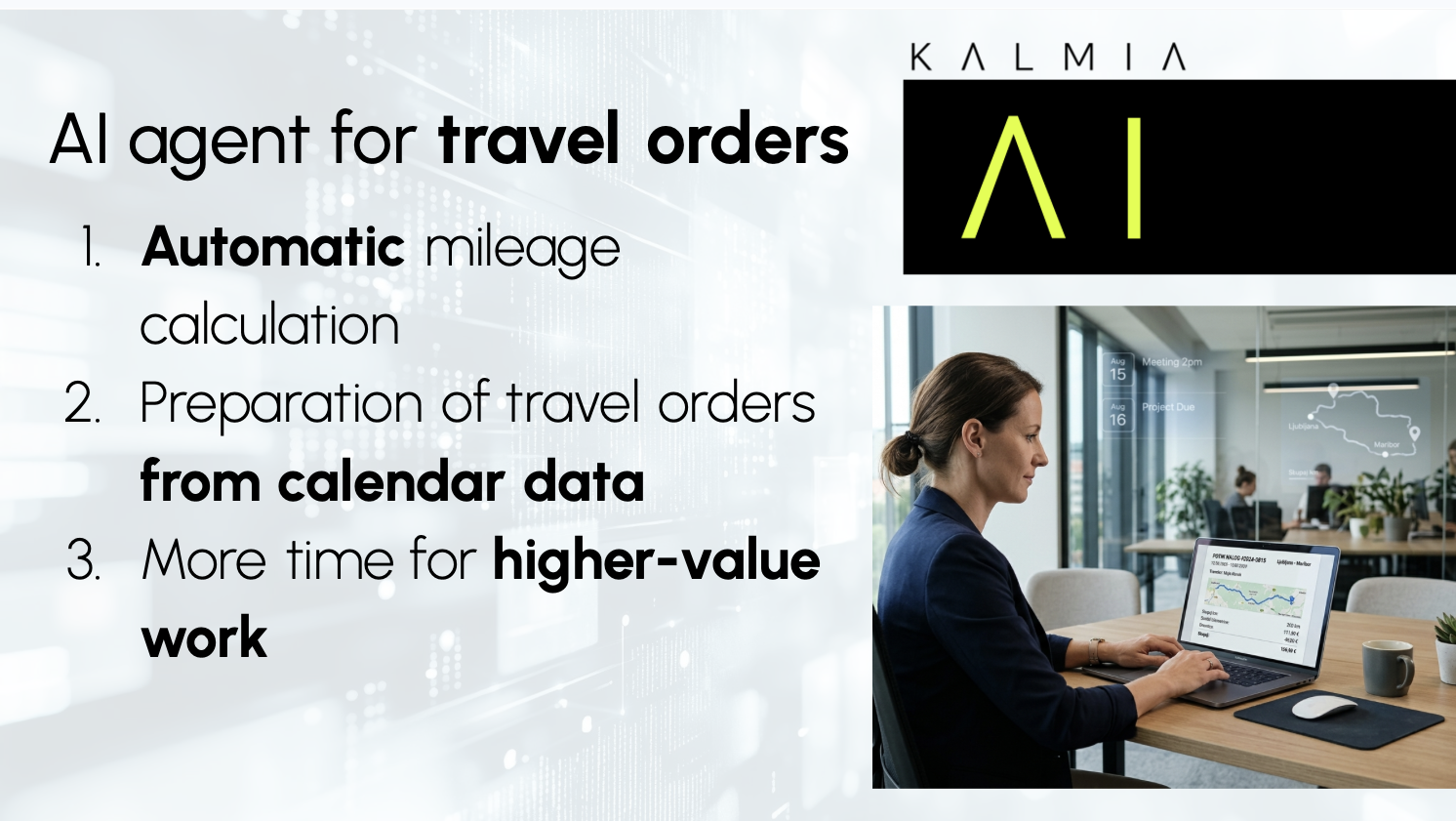
Have you ever calculated how much time your employees spend on travel orders?
In most companies, the end of the month brings the same picture: employees sitting in front of their calendars, trying to reconstruct their trips. Where was I on Wednesday? Was the meeting in Maribor or online? How many kilometers was that?
The result? Lost time, guesswork, and unnecessary frustration.
The value of your employee is not in manually calculating mileage, but in their expertise. What matters more is that they have time to prepare for meetings, talk to clients, or solve more complex tasks — not fill out forms.
This is where an AI agent for travel order automation comes in — a solution that invisibly pushes administrative work into the background.
Why travel orders become an administrative bottleneck
Travel orders are a typical example of a process that is simple in itself, yet time-consuming. There are several reasons for this:
-
Fragmentation: Meetings are scattered across calendars.
-
Incomplete data: Locations in calendars are often missing or insufficient.
-
Manual work: Mileage is calculated manually or using online maps.
-
Delays: Orders are often completed retroactively, when memory is no longer fresh.
-
Scalability: Administration grows with company size.
The process requires time and attention — two resources companies are always short on. When such procedures repeat, they become a silent administrative burden across the organization.
How an AI agent takes over your “dirty work”
Instead of chasing data across your calendar and emails, an AI agent proactively monitors your work and prepares documentation drafts in real time, in five steps:
Step 1: Calendar monitoring
The agent runs in the background, tracking business calendars and detecting new meetings or business absences.
Step 2: Location detection
When a meeting is detected, it checks the event location. If it is outside the usual workplace, the system recognizes the need for a travel order.
Step 3: Instant draft creation
It extracts key data from the calendar: who attended, where the meeting took place, and how long it lasted.
Step 4: Automatic cost calculation
Based on detected locations, the agent calculates distance and prepares an estimate of travel costs.
Step 5: Review and confirmation
Instead of time-consuming manual entry, the user opens a list of prepared travel orders, reviews them, and confirms them. What used to take minutes is reduced to seconds.
Why a typical AI assistant can’t do this
An AI assistant waits for your command and then helps you fill out a travel order. An AI agent, on the other hand, handles documentation before you even think about it, because it:
-
monitors the calendar,
-
detects business trips,
-
prepares draft orders,
-
calculates travel costs.
Such an AI agent can almost completely eliminate administrative work — it operates proactively, not only when an employee starts filling out a form.
Where this type of automation has the greatest impact
The biggest impact is seen where business travel is part of everyday work and bureaucracy disrupts workflow.
This is often the case for:
-
sales and service teams: instead of dealing with forms in the field, they can focus on customers,
-
consulting companies: where every hour counts and travel tracking must be precise for billing,
-
executives: who are constantly in meetings and don’t have time to reconstruct their schedules.
The true power of the agent becomes clear in companies with dozens or hundreds of employees. Manually checking travel orders in large organizations is an administrative nightmare. An AI agent scans the entire team’s calendars simultaneously, standardizes data, and drastically reduces the workload for finance departments.
What an AI agent brings to a company
When repetitive administrative tasks are handled by a system, the dynamics of work change.
Companies benefit from:
-
less manual data entry,
-
fewer errors in travel orders,
-
better visibility into business travel,
-
reduced administrative workload for employees and finance teams.
Because travel data is collected more systematically and accurately, it becomes easier to analyze. Companies gain a more realistic view of travel costs, can identify patterns, and plan future travel budgets more reliably.
Employees gain something very valuable — they no longer have to think about travel orders. The system prepares them automatically; they just confirm them.
Security as a foundation, not an obstacle
Access to business calendars often raises security concerns. But let’s be honest: manually copying data into spreadsheets can sometimes be a greater risk than controlled automation. Human errors and inconsistent data are what actually cause headaches for finance departments.
To ensure your automation is seamless and secure, at Kalmia we design security architecture with security as the top priority:
-
clearly defined calendar access permissions,
-
traceability of changes and system activity,
-
secure data processing,
-
the option to run within the company’s internal infrastructure.
The agent can act as an assistant that prepares drafts or as a fully automated system — depending on your level of trust and how you want to manage the process.
At Kalmia, we implement such solutions in a process-driven way: first we analyze existing workflows, then build an architecture that is secure, transparent, and tailored to the company environment.
AI agent as the end of administrative routine
Travel orders are not tasks that create value for a company. Nor are they an area where you outperform competitors. They are simply a necessary burden that consumes time and money.
When an AI agent takes over the process, administration becomes invisible infrastructure. Your people should focus on what they were hired for and do best — projects, sales, and strategy. Let technology handle the documentation.
The first step is not implementation, but analysis. In a free consultation, we can assess how many hours your team could gain by automating travel orders.