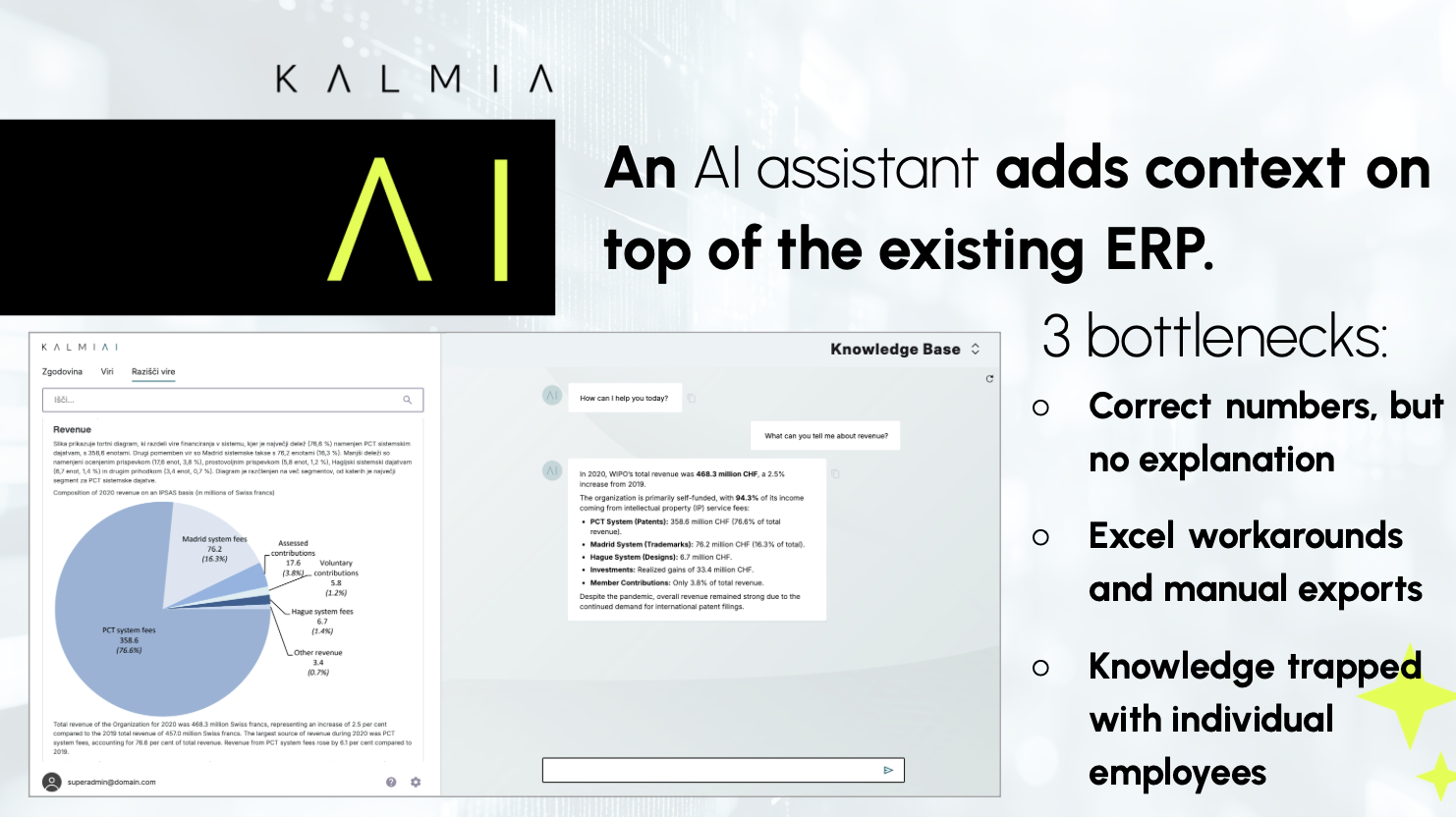
ERP systems in companies have long ceased to be a matter of choice. They are the foundation of operations, record-keeping, and reporting.
Even though they function well, they were not designed to explain and connect information the way companies need today.
In practice, ERP systems are often rigid and slow, poorly aligned with actual business processes, and difficult to integrate with other tools employees use.
As a result, user experience suffers, work slows down, and answers often exist only with specific individuals — colleagues who are the only ones who know how to enter or verify something, while others rely on separate Excel sheets.
In practice, we often encounter two scenarios.
If most of your operations run in Excel spreadsheets and this works well for your company, it may be a sign that an ERP system is not yet essential for your needs.
In that case, it makes sense to ask how to make Excel work for you — rather than how to replace it. We discuss this here: How to Transform Excel Sheets into a Powerful Application?
If you already use an ERP system but still face workarounds, repeated questions, and manual explanations, let’s look at three very common real-world examples where an AI assistant can help save time.
Regardless of whether you use established ERP solutions such as SAP, MS Dynamics Business Central, or Odoo, companies often face similar day-to-day challenges.
When the Numbers Match, but the Decision Still Waits
The Challenge
Management has access to reports. The numbers match, the periods are correct, and the calculations are accurate.
Yet during meetings, the same questions arise:
“Why is this cost higher than last month?”
“What exactly is included in this item?”
“Why does this report differ from the Excel analysis?”
An ERP system tells you what happened.
It does not explain why — or what it means in practice.
As a result, employees often export numbers to Excel again, add comments and additional explanations. The decision waits until someone connects the context.
How an AI Assistant Helps
An AI assistant does not change data and does not replace the ERP.
It reads existing reports, internal explanations, and supporting documents and helps answer questions in natural language.
Instead of searching through multiple files, management can ask:
“Why did cost X increase compared to last month?”
“What is included in this item?”
The assistant connects the data with explanations and shows what the answer is based on.
Result
Fewer meetings spent explaining numbers.
More time for decision-making.
The numbers are not only correct — they become understandable.
When the System Doesn’t Cooperate, the Company Creates Workarounds
The Challenge
Despite its stability, an ERP system is often closed and difficult to integrate with other tools. When employees need a quick overview, comparison, or additional clarification, they:
-
export data,
-
process it manually,
-
combine it with other sources.
At first, these are temporary solutions. Over time, they become a permanent part of the process.
Parallel lists emerge, different versions of the same data — solutions no one truly controls anymore.
How an AI Assistant Helps
An AI assistant operates on top of existing systems and documents.
Instead of new exports, it allows employees to ask questions directly over existing data and explanations.
It does not create new tables but helps interpret the existing ones.
Employees can ask:
“Which data is included in this export?”
“How is this number connected to the previous report?”
Result
Fewer manual workarounds.
Fewer “temporary” solutions.
The ERP remains the backbone of records, without additional confusion building around it.
When You Have to Ask a Colleague Because You Don’t Understand the System
The Challenge
ERP systems are built for entries.
For accurate postings, records, and documentation.
But when someone asks:
“Why is this like this?”
“What does this mean for me?”
“What is the next step?”
The answer is often not found in the system — but with a specific person.
Accounting or administration becomes an internal helpdesk. Not because they want to — but because the system cannot answer questions.
How an AI Assistant Helps
An AI assistant becomes the first point of contact for questions.
It reads internal documents, procedures, explanations, and reports and responds the way an experienced colleague would — only it is always available.
Instead of sending an email or interrupting someone’s work, employees can ask:
“What does this item mean?”
“How is this handled in our company?”
Result
Fewer work interruptions.
Less dependency on individuals.
Company knowledge becomes accessible to everyone — not just those who master the ERP.
AI Assistant: Let Your ERP Finally Start Working with Your Employees
An AI assistant does not interfere with your ERP data and does not change your processes.
It acts as an explanatory layer on top of existing systems — exactly where questions, workarounds, and unnecessary interruptions arise today.
When employees get answers directly from the company’s knowledge system, the ERP finally becomes a decision-support tool, not just a record-keeping system.
Together with Kalmia, you can ensure that your existing technology and systems start working in your favor — without major overhauls, but with very tangible results.