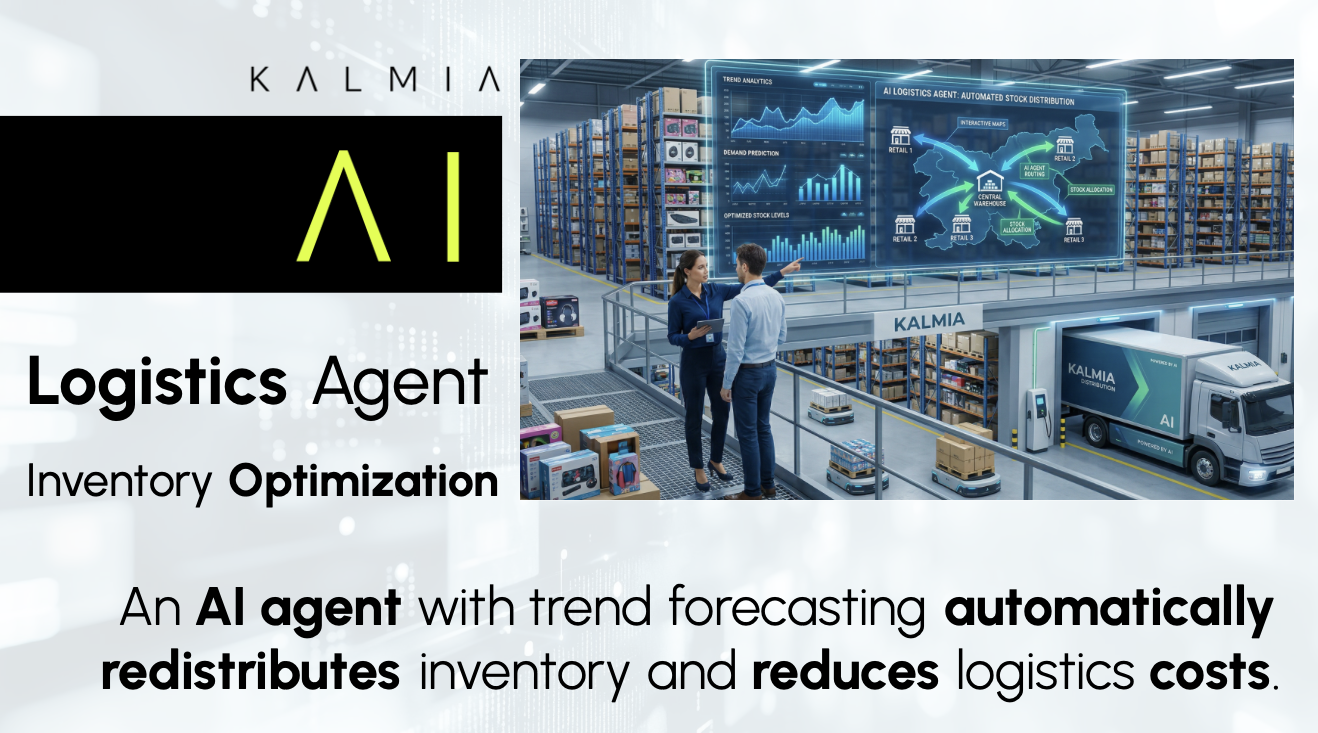
In the world of large-scale retail, inventory management often feels like playing chess on thousands of boards at once. You have dozens of stores, multiple central warehouses, and thousands of products moving to the rhythm of seasonal trends, sudden promotions, or even the weather.
The traditional approach? Excel spreadsheets, manual stock checks, and decisions based on “gut feeling.” The result is often empty shelves in one location, while products pile up in storage at another.
At Kalmia, we believe it’s time for digital transformation to take over this process. Meet the AI logistics agent.
Why guess when AI can predict?
A logistics agent is not just another inventory management tool. It’s an intelligent system that works like a tireless analyst who never sleeps. Its main task in large retail chains is the automatic distribution of products between warehouses and stores.
Instead of waiting for stock in a specific store to fall below a critical level, the AI agent analyzes historical trends and predicts in advance where demand will be highest.
How does it work in practice?
-
Data analysis: The agent connects to your ERP system and monitors sales and historical data.
-
Pattern recognition: Based on past data and current market dynamics, it determines that a certain product will sell faster in one location than another.
-
Automatic redistribution: The agent independently creates transfer orders, moving products from warehouses with excess stock to locations where shortages are expected.
Responsiveness that delivers results
When we talk about AI agents in logistics, we’re not just talking about technology—we’re talking about business value. When the system takes over routine and complex planning, the entire company dynamic changes:
-
Storage cost optimization: Less dead capital sitting on shelves collecting dust.
-
Increased sales: Products are always where customers are. No more disappointed shoppers facing empty shelves.
-
Reduced logistical pressure: Transport is planned more intelligently, routes are shorter, and vehicle utilization is higher.
-
Team relief: Your experts can focus on strategy and supplier relationships instead of crunching numbers in spreadsheets.
Would an AI assistant help?
An AI logistics agent enables automation where actions are carried out independently, requiring only human confirmation and data verification when needed. An AI assistant, on the other hand, can complement the system as a conversational interface for queries and questions. Through a simple chat interface, it can generate:
-
daily route reports,
-
analysis of best-selling products,
-
issue reports,
-
transport cost reports.
Adding an AI assistant alongside the AI agent brings even greater value to the system.
The future isn’t “more work,” but “smarter work”
Digital transformation in retail is no longer a matter of prestige—it’s a matter of survival. Implementing an AI agent that understands logistics trends means shifting from reactive to proactive operations. Instead of putting out fires when stock runs out, you build a system that prevents them before they start.
At Kalmia, we don’t just build software—we build digital colleagues that make your business agile, resilient to change, and above all, profitable.