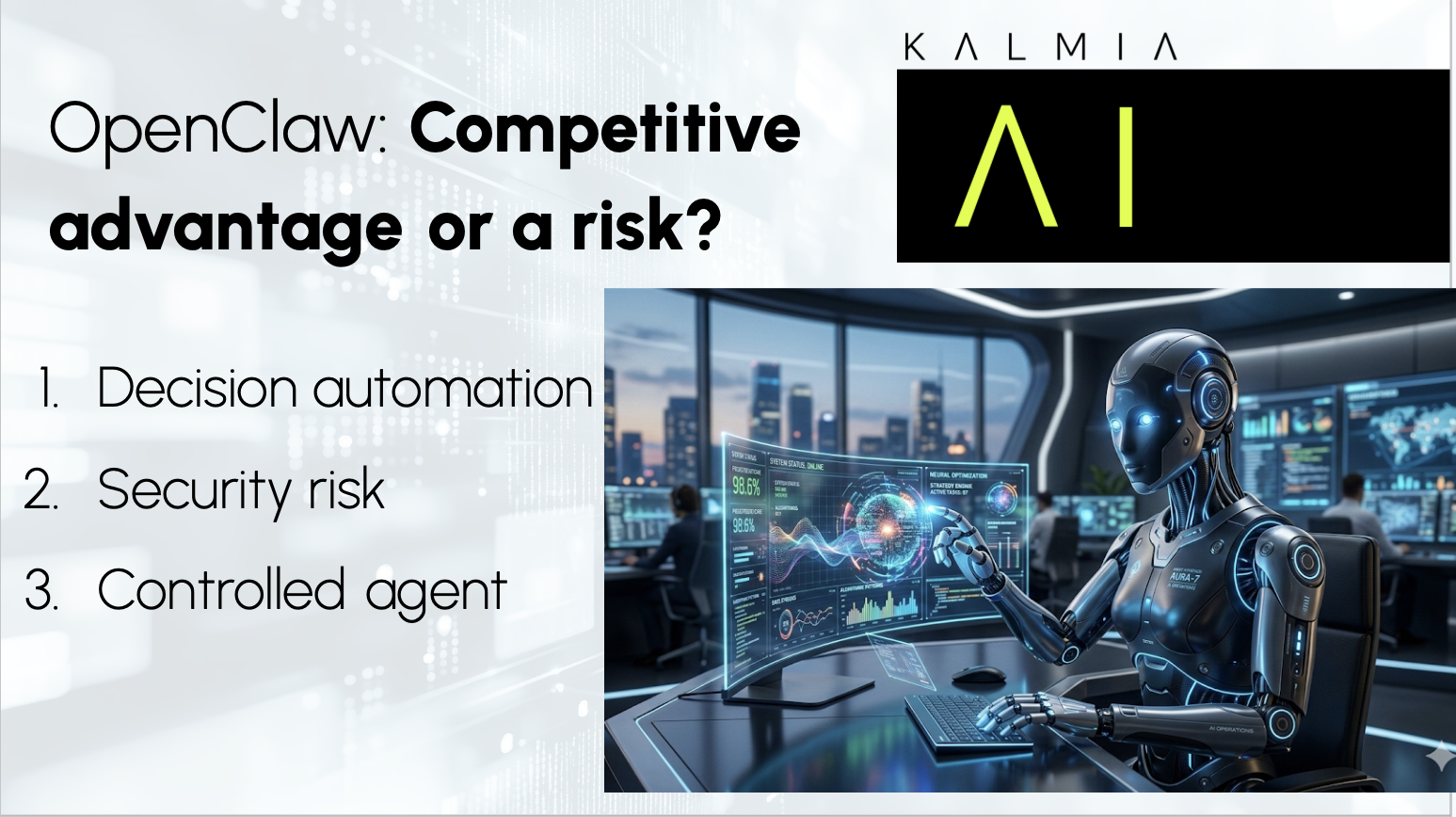
OpenClaw has become one of the most talked-about topics when it comes to AI agents.
For the first time, artificial intelligence is no longer confined to a chat window - it becomes part of your workflow. It can access systems, check data in your ERP, read documents, and trigger tasks.
This can mean greater efficiency, but it also raises a critical question of safety.
OpenClaw can operate with very broad privileges, so by itself it is not an ideal business solution. It is a powerful tool that, without clear limits and oversight, can pose a significant security risk. Examples like the one below demonstrate how quickly an experiment can turn into a major problem.

What Does an AI Agent Mean in Practice?
At 9:05 a.m., the procurement manager receives a notification:
-
“Material X will fall below the minimum threshold in 6 days.”
-
“Suggested order: 4,200 units from Supplier Z.”
-
“Delay risk: 20%. Alternative: Supplier A.”
There’s no need to manually check consumption data to make comparisons. The system has already connected historical usage, sales forecasts, and supplier reliability to produce a concrete recommendation.
The manager reviews the suggestion, clicks Confirm, and continues with their work.
How Did This Happen?
This is not a “slightly better” chatbot or an AI assistant.
-
AI assistant: helps you understand information.
-
AI agent: begins executing tasks.
Most companies today already use AI assistants — chat interfaces that can find internal documents, summarize policies, or pull system data.
If the same procurement manager relied solely on an AI assistant, they would have to ask at 9:05:
-
“What is the current stock of Material X?”
-
“What was the average consumption over the past six months?”
-
“Which supplier had the fewest delays?”
They would get quick and clear answers — but the key steps, like comparison, risk assessment, and preparing the order, would still be done manually. If the stock isn’t checked on time, it could already be too late.
Imagine a Top Athlete with an Assistant vs. an Agent
-
Assistant: handles specific tasks on demand — schedule, logistics, organization.
-
Agent: thinks more broadly — monitors opportunities, closes deals, ensures long-term success — even when no explicit request is made.
Similarly, in a company:
-
AI assistant reacts only when prompted.
-
AI agent is tightly integrated with processes, triggers analyses automatically, and prepares next steps when deviations occur.
What Needs to Happen Behind the Scenes
This transition isn’t achieved by a better prompt alone.
An AI agent must be able to:
-
read data from ERP or other business databases
-
connect multiple systems
-
operate periodically, not just on demand
-
have clearly defined boundaries and permissions
This is where frameworks like OpenClaw come in. They help build AI agents by connecting LLMs to your systems and clearly defining data access boundaries.
It’s important to understand that an AI agent is never just a single entity. It always consists of at least:
-
an LLM model (e.g., Claude, ChatGPT)
-
an agent layer that grants access to documents and applications while enforcing operational limits
What Could Go Wrong?
OpenClaw is technically impressive, enabling fast connection of models to various systems and process automation. But here lies the risk.
When the tool has broad access to your documents and systems, it becomes part of your infrastructure. In large companies, infrastructure carries legal, operational, and security responsibility.
If boundaries aren’t clearly defined, the agent might access unnecessary data or trigger processes without proper oversight.
It must be crystal clear:
-
what data the agent can access
-
what actions it can perform
-
how its activities are logged
-
where the decision-making model runs
How to Build a Safe AI Agent
The more the AI agent can do, the greater the company’s responsibility to define its operational framework.
Key points:
-
LLMs should run in restricted, traceable environments.
-
Models should not operate as public cloud services, but on internal servers, ensuring data never leaves company infrastructure.
At Kalmia, we implement these systems gradually — with limited permissions, clear traceability, and oversight of what the agent can and cannot do.
The goal is not automation at any cost, but a stable system where AI performs parts of the process without becoming an operational risk.
Make the AI Agent Your Competitive Advantage
An AI agent should not be an experiment; it should be a planned infrastructural decision.
When designed correctly, it:
-
reduces response times
-
lowers manual workload
-
increases process oversight
-
without adding risk
At Kalmia, we set up agents to relieve key personnel and optimize processes, while the company retains full control over data.
If you are considering AI agents, the first step is always a consultation — to explore how they can be safely and thoughtfully integrated into your company.